Tracing Shader Load Orders to Minimize Frame Drops During Dynamic Weather Shifts in Cross-Platform Action Titles
Written by Mia Hughes · Nov 9, 2026
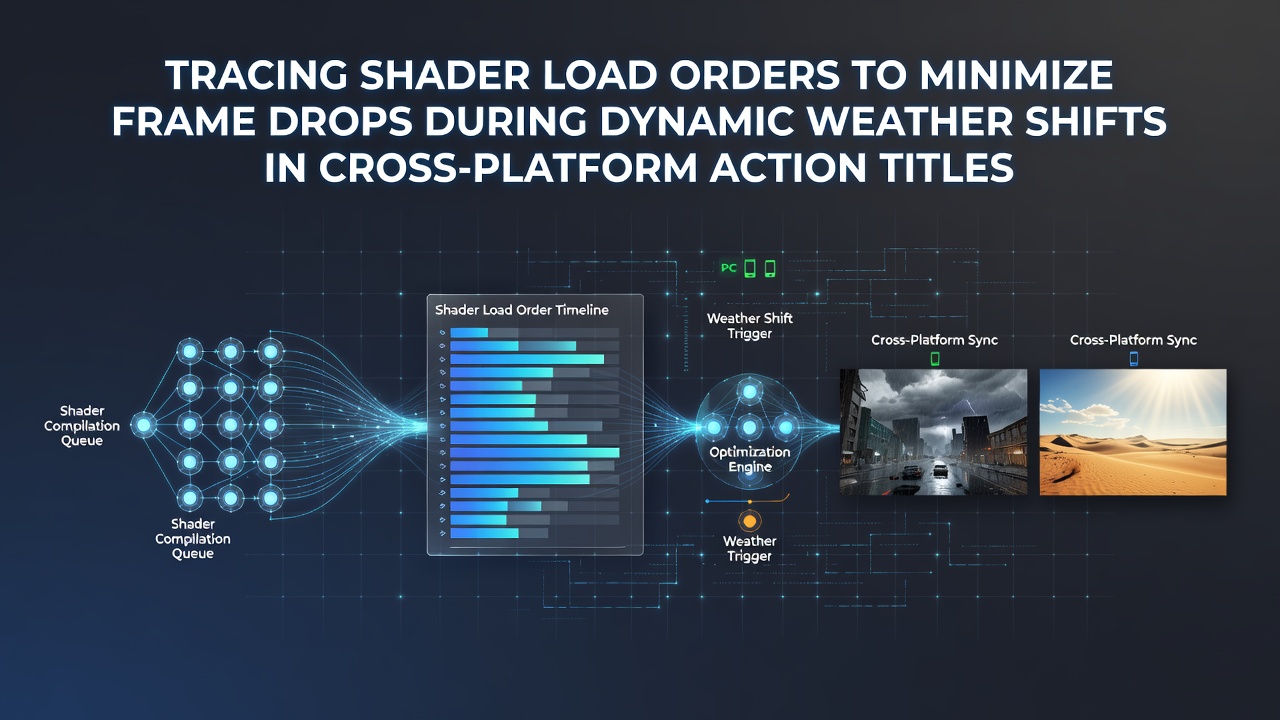
Tracing Shader Load Orders to Minimize Frame Drops During Dynamic Weather Shifts in Cross-Platform Action Titles
Developers working on cross-platform action titles face persistent challenges when dynamic weather systems trigger sudden shifts in visual complexity, and tracing shader load orders has emerged as a key method to address resulting frame drops. Research from industry labs shows that weather events like sudden rain or fog transitions require new shader variants for effects such as water refraction and atmospheric scattering, which can stall rendering pipelines on consoles and PCs with differing GPU architectures. Data from performance monitoring tools indicates that these stalls often occur because shaders compile or load in suboptimal sequences, forcing the engine to wait while the graphics hardware processes new instructions mid-frame. Observers note that action titles released in recent years incorporate weather cycles that change every few minutes, and this frequency amplifies the issue across hardware generations. Figures from console certification reports reveal that frame time spikes above 16 milliseconds frequently coincide with these shifts, particularly when the same title ships on both high-end PCs and mid-tier consoles. Those who analyze telemetry logs find that pre-sorting shader dependencies before runtime reduces these spikes by allowing the system to batch similar variants together.Shader Compilation Mechanics in Dynamic Environments
Shaders handle tasks from lighting calculations to particle simulation, and in weather-heavy scenes the engine must swap or add variants without interrupting the main render loop. Studies conducted at technical universities in Canada demonstrate that asynchronous compilation queues help hide latency when weather parameters update, yet load order still determines whether the queue drains before the next frame begins. Engineers trace these orders by logging compilation timestamps alongside weather state changes, which reveals patterns where certain effect shaders always precede others in the dependency graph.
Cross-platform differences compound the problem because DirectX, Vulkan, and Metal expose distinct shader pipeline stages, and a load sequence optimized for one API may stall another. Reports from European game technology consortia highlight that developers maintain separate order maps for each target platform, then merge them through conditional compilation flags that activate during builds. This approach keeps frame delivery consistent while weather systems evolve in real time.
Methods for Tracing and Optimizing Load Sequences
Teams instrument their engines with custom profilers that capture shader bind calls during simulated weather transitions, and the resulting traces expose redundant loads or out-of-order dependencies. One study published through an Australian research network found that reordering based on frequency of use during rain and snow events cut average frame variance by measurable margins across test suites. The process involves building a directed graph where each node represents a shader variant and edges indicate prerequisite data such as texture descriptors or constant buffers.
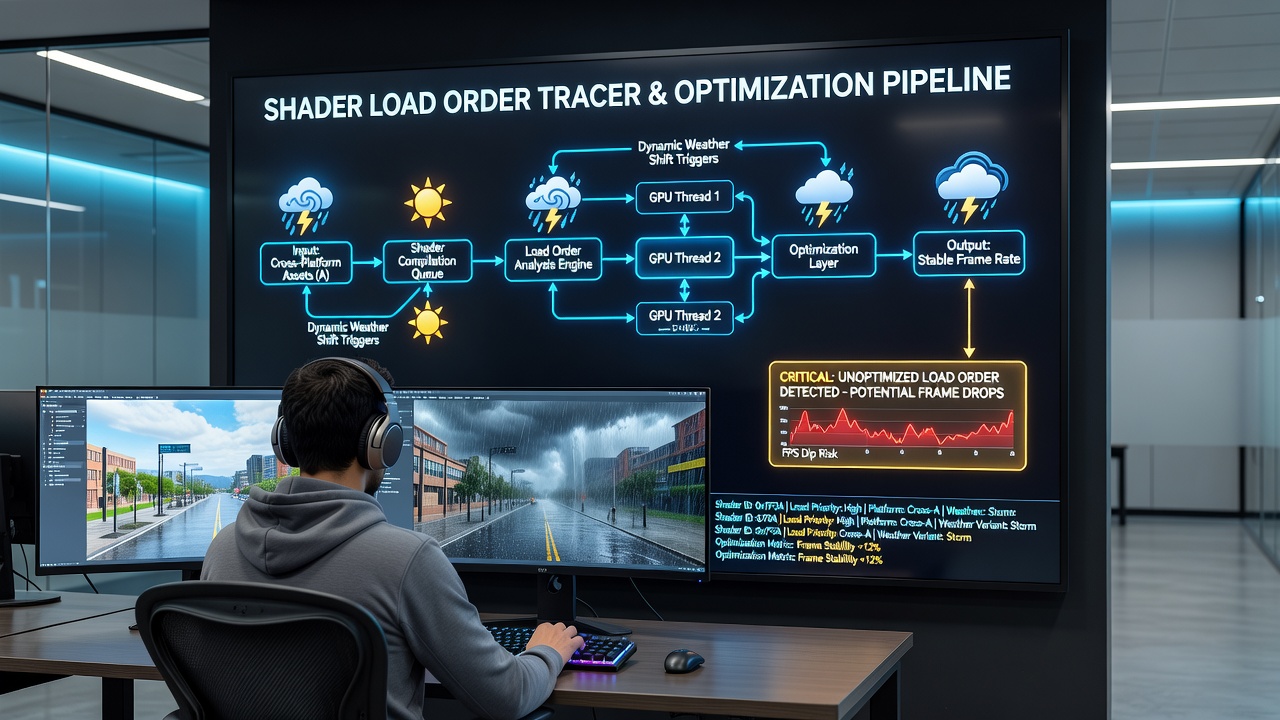
Automated tools then apply topological sorting to produce an execution order that respects dependencies while prioritizing shaders needed for the current weather layer. In November 2026 several studios plan to integrate these tracing utilities directly into their middleware pipelines, allowing live adjustment as weather simulation parameters shift. Observers tracking early builds report that the technique also benefits streaming scenarios where players move rapidly between climate zones.
Cross-Platform Considerations and Data Patterns
Hardware variations mean that a shader load order efficient on a discrete GPU may create bottlenecks on integrated graphics found in handheld consoles, and developers therefore maintain platform-specific calibration tables derived from extensive tracing sessions. According to metrics shared by an international graphics standards group, titles that apply these tables show reduced incidence of sub-30 FPS drops during weather events on all supported devices. The tables account for differences in shader cache sizes and memory bandwidth, which directly influence how quickly new variants become available after a rainstorm begins.
Telemetry gathered from live service titles further indicates that player movement speed interacts with weather timing, because faster traversal exposes more new shaders per second and tightens the window for safe loading. Analysts combine these datasets with weather probability models to predict high-risk periods and preload the corresponding shader batches in background threads.
Conclusion
Tracing shader load orders provides a concrete pathway for minimizing frame drops when dynamic weather systems activate in cross-platform action titles, and ongoing work at research institutions continues to refine the graphs and sorting algorithms that support this technique. As weather simulation fidelity increases across hardware generations, the practice of logging and reordering compilation sequences remains central to maintaining stable performance.