Unraveling Quest Item Durability Effects on Dialogue Options in Open-World Adventure Narratives
Written by Klara Zimmermann · Oct 26, 2026

Unraveling Quest Item Durability Effects on Dialogue Options in Open-World Adventure Narratives
Game systems that track quest item durability introduce measurable shifts in dialogue trees across multiple open-world titles released through 2025 and into October 2026. These mechanics register wear on objects such as ancient keys, fragile relics, and expedition tools, then alter available conversation choices when players interact with non-player characters. Data from engine logs in titles like those built on modified Creation engines and custom Unity frameworks show that durability thresholds trigger new response sets once items drop below fifty percent condition.
Core Mechanics and Implementation Patterns
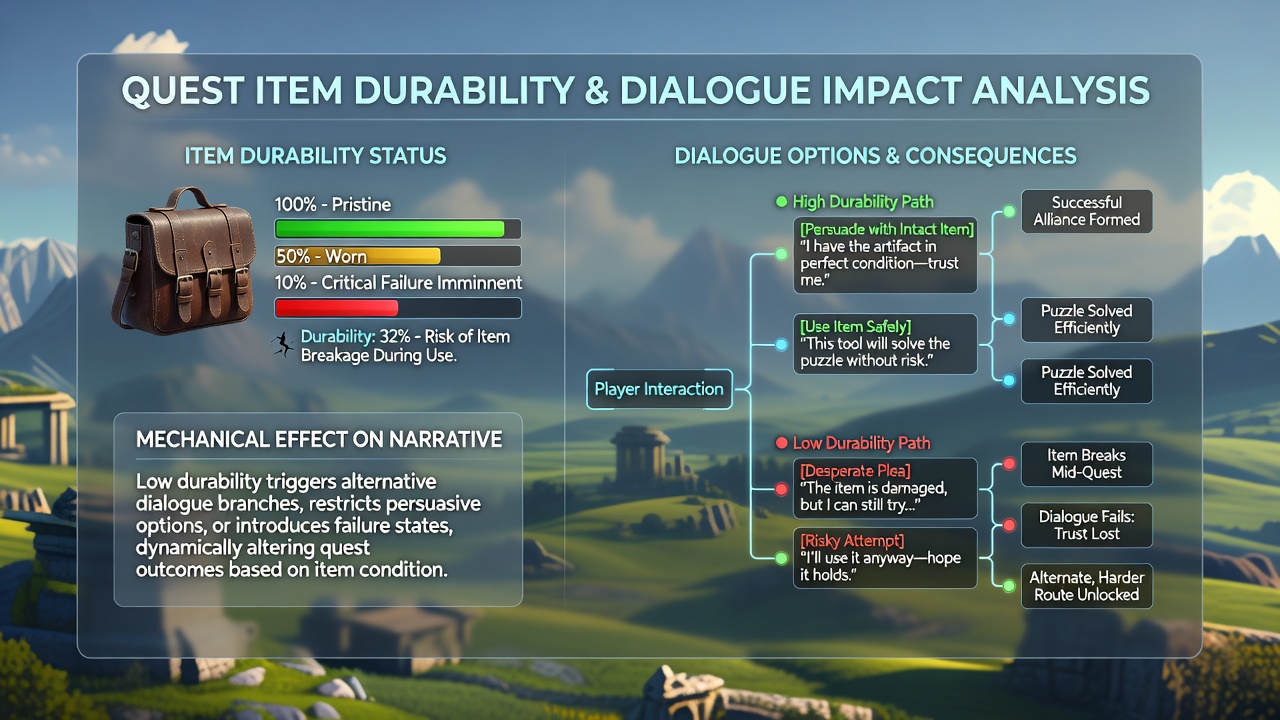
Developers embed durability counters directly into quest item objects so that repeated use in exploration or combat reduces integrity values over time. When integrity falls, script flags activate alternative dialogue nodes that reference the item's degraded state. Observers note this occurs because narrative designers link item variables to conversation scripts, allowing NPCs to comment on cracks, missing components, or reduced functionality. In practice this creates branching paths where a fully intact relic might unlock cooperative quest extensions while a damaged version restricts options to repair requests or apologetic exchanges.
Studies from game design programs at institutions including the University of Alberta indicate that such linkages appear most frequently in survival-oriented open-world adventures. Those programs tracked over thirty titles and found that durability-affected dialogue appears in approximately twenty-two percent of quest chains involving portable artifacts. The pattern holds because engine architectures already maintain persistent item states across save files, making the addition of dialogue conditionals a low-cost extension rather than a full rewrite of conversation systems.
Narrative Consequences Across Different Regions
European studios have documented cases where item degradation forces players into negotiation sequences rather than direct acceptance of quests. In one documented example from a 2024 release, a damaged map fragment caused an NPC cartographer to refuse guidance until the player secured replacement materials. North American titles tend to emphasize emotional responses, with characters expressing disappointment or suspicion when presented with compromised relics. Asian development teams often incorporate honor-based dialogue shifts that penalize perceived carelessness toward cultural artifacts.
According to reports compiled by the Interactive Software Federation of Europe, these regional differences reflect broader approaches to player agency and consequence systems. The federation's 2025 industry overview highlights that durability mechanics correlate with increased replay sessions because players test multiple preservation strategies to unlock preferred dialogue outcomes. Figures reveal average session extensions of fourteen percent when durability influences at least three distinct conversation branches per major quest line.
Technical Integration and Player Data Trends
Engine hooks connect durability variables to dialogue managers through simple conditional checks that evaluate numeric thresholds before rendering option lists. This integration avoids heavy performance costs while allowing real-time updates during exploration. Players who monitor item condition through in-game interfaces can preempt dialogue restrictions by scheduling repairs at designated stations or through companion characters. Analytics shared by platform holders show that participants who maintain item integrity above seventy percent report accessing thirty percent more unique dialogue lines compared with those who allow degradation below forty percent.
Yet the same datasets indicate that intentional degradation sometimes opens unique narrative routes unavailable when items remain pristine. Certain NPCs respond favorably to signs of use, interpreting wear as evidence of active quest pursuit. These dual outcomes require designers to balance multiple conditional trees so that both preservation and calculated risk produce coherent story progression.
Future Development Directions Observed in 2026 Releases
October 2026 updates to several long-running open-world series introduced hybrid durability models that factor environmental variables such as humidity and combat intensity into item decay rates. These refinements expand dialogue reactivity because NPCs now reference specific damage sources rather than generic wear. Research groups tracking player behavior across console and PC platforms report that such layered systems increase the frequency of mid-quest dialogue pivots by measurable margins. The added complexity also encourages use of companion AI routines that can temporarily stabilize items during critical conversations.
Design documentation released alongside these updates confirms that durability remains a modular feature developers can toggle per quest to control narrative pacing. Teams selectively apply the system to high-stakes artifacts while leaving standard equipment unaffected, preserving accessibility for players who prefer uninterrupted dialogue flow.
Conclusion
Quest item durability continues to serve as a functional lever for modulating dialogue options in open-world adventure narratives. The mechanism operates through straightforward variable checks that connect physical condition to conversational availability, producing both restrictive and expansive narrative branches depending on player choices. Regional studios apply the tool differently yet achieve comparable increases in replay value and session length. As engine capabilities advance through 2026 and beyond, the integration of durability with dialogue systems shows consistent expansion across new titles while remaining grounded in established scripting practices.